\`x^2+y_1+z_12^34\`
Advanced Search
Article Contents
Article Contents

Using the Newton-Raphson method with Automatic Differentiation to numerically solve the implied volatility of stock options via the Binomial model

  • *Corresponding author: Kirill V. Golubnichiy

    *Corresponding author: Kirill V. Golubnichiy
Abstract / Introduction Full Text(HTML) Figure(5) / Table(2) Related Papers Cited by
  • In the paper by Michael Klibanov et al. [7], a novel method is proposed to calculate the implied volatility of European stock options as a solution to the ill-posed inverse problem for the Black-Scholes equation. Additionally, the paper introduces a trading strategy based on the difference between the implied volatility of the option and the volatility of the underlying stock. Besides the Black-Scholes equation, the Binomial model is another method used to price European options, and the implied volatility can also be calculated using this model. In this paper, we apply the Newton-Raphson method in conjunction with Automatic Differentiation to numerically approximate the implied volatility of a stock option using the Binomial/Lattice model [4]. We provide an explanation of the mathematical model, the methodology, and the results from our tests using simulated data from the Geometric Brownian Motion model and the Binomial model itself, as well as data from the U.S. market from 2020 to 2022.

    Mathematics Subject Classification: Primary: 91G60, 60H15, 35R30.

    Citation:

    \begin{equation} \\ \end{equation}
  • 加载中
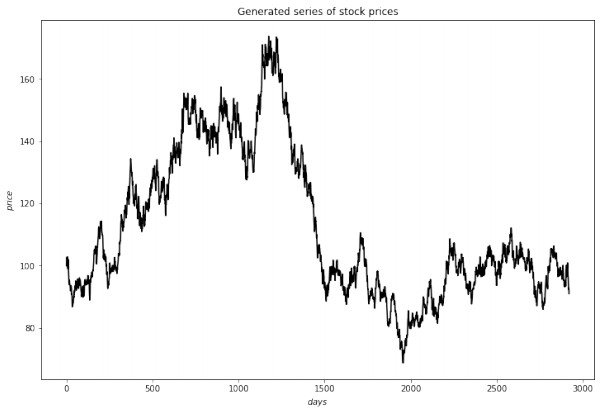
  • Figure 1.  Simulated stock price based on Geometric Brownian motion.

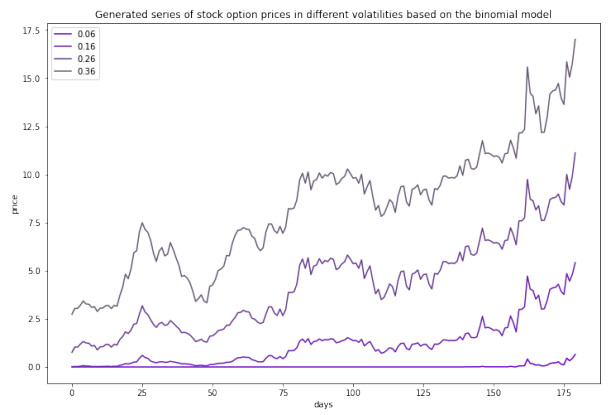
    Figure 2.  An example of simulated option prices generated from the stock prices above and the Binomial model with four different volatilities, a strike price of 150, and a fixed maturity of 180 days.

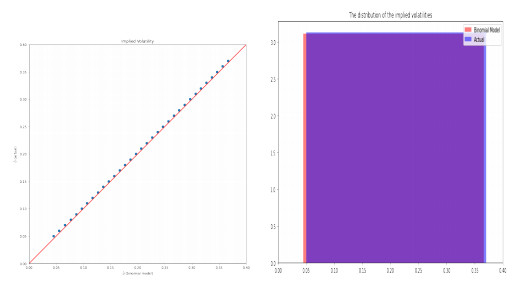
    Figure 3.  (left) The scatter plot of implied volatilities calculated from the binomial model and their corresponding actual values from the dataset (Generated Data); (right) The implied volatilities distributions (Generated Data).

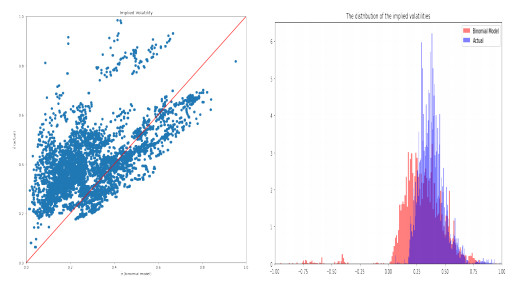
    Figure 4.  (left) The scatter plot of implied volatilities calculated from the binomial model and their corresponding actual values from the dataset (The 2017-2018 US market); (right) The implied volatilities distributions (The 2017-2018 US market).

    Figure 5.  (left) The scatter plot of implied volatilities calculated from the binomial model and their corresponding actual values from the dataset (The 2020-2021 US market); (right) The implied volatilities distributions (The 2020-2021 US market).

    Table 1.  Generated Data (of total 1350 data).

    Secant Autodiff
    Number of Convergences 1322 1308
    Average Number of Iterations 3.670 3.352
     | Show Table
    DownLoad: CSV

    Table 2.  Real Data (of total 1917 data).

    Secant Autodiff
    Number of Convergences 1431 1425
    Average Number of Iterations 6.304 4.700
     | Show Table
    DownLoad: CSV
  • [1] A. G. Baydin, B. A. Pearlmutter, A. A. Radul and J. M. Siskind, Automatic differentiation in machine learning: A survey, Journal of Machine Learning Research, 18 (2017), 1-43. 
    [2] F. Black and M. Scholes, The pricing of options and corporate liabilities, World Scientific Reference on Contingent Claims Analysis in Corporate Finance: Foundations of CCA and Equity Valuation, 1 (2019), 3-21. doi: 10.1142/9789814759588_0001.
    [3] R. M. Corless and N. Fillion, A Graduate Introduction to Numerical Methods, Springer, New York, 2013.
    [4] J. C. Cox, S. A. Ross and M. Rubinstein, Option pricing: A simplified approach, Journal of financial Economics, 7 (1979), 229-263.  doi: 10.1016/0304-405X(79)90015-1.
    [5] J. Hull, Options, Futures and Other Derivatives, 9$^{th}$ edition, Prentice Hall, Upper Saddle River 2014.
    [6] Y. S. Kim, S. Stoyanov, S. Rachev and F. Fabozzi, Multi-purpose binomial model: Fitting all moments to the underlying geometric Brownian motion, Economics Letters, 145 (2016), 225-229.  doi: 10.1016/j.econlet.2016.05.035.
    [7] M. V. Klibanov, A. A. Shananin, K. V. Golubnichiy and S. M. Kravchenko, Forecasting Stock Options Prices via the Solution of an Ill-Posed Problem for the Black-Scholes Equation. arXiv: 2202.07174, Inverse Problems, 38 (2022).
    [8] A. Meurer, C. P. Smith, M. Paprocki, O. Čertík, S. B. Kirpichev, M. Rocklin, A. Kumar, S. Ivanov, J. K. Moore, S. Singh, T. Rathnayake, S. Vig, B. E. Granger, R. P. Muller, F. Bonazzi, H. Gupta, S. Vats, F. Johansson, F. Pedregosa, M. J. Curry, A. R. Terrel, Š. Roučka, A. Saboo, I. Fernando, S. Kulal, R. Cimrman and A. Scopatz, SymPy: Symbolic Computing in Python, PeerJ Computer Science, 3, e103, 2017.
    [9] L. B. Rall and G. F. Corliss, An introduction to automatic differentiation. computational differentiation: Techniques, Society for Industrial and Applied Mathematics (SIAM), Philadelphia, PA, 89 (1996), 1-18. 
    [10] S. M. Ross,  An Elementary Introduction to Mathematical Finance, Cambridge University Press, 2011. 
  • 加载中

Figures(5)

Tables(2)

SHARE

Article Metrics

HTML views(4701) PDF downloads(243) Cited by(0)

Access History

Catalog

    /

    DownLoad:  Full-Size Img  PowerPoint
    Return
    Return