\`x^2+y_1+z_12^34\`
Advanced Search
Article Contents
Article Contents

A nonlinear attraction-repulsion Keller–Segel model with double sublinear absorptions: criteria toward boundedness

  • *Corresponding author: Giuseppe Viglialoro

    *Corresponding author: Giuseppe Viglialoro

YC is supported by JSPS KAKENHI, Grant Number: JP22J11422. SF and GV are members of the Gruppo Nazionale per l'Analisi Matematica, la Probabilità e le loro Applicazioni (GNAMPA) of the Istituto Nazionale di Alta Matematica (INdAM) and are partially supported by the research projects Evolutive and Stationary Partial Differential Equations with a Focus on Biomathematics (2019, Grant Number: F72F20000200007) and Analysis of PDEs in connection with real phenomena (2022), funded by Fondazione di Sardegna (2021, Grant Number: F73C22001130007). GV is also partially supported by MIUR (Italian Ministry of Education, University and Research) Prin 2017 Nonlinear Differential Problems via Variational, Topological and Set-valued Methods (Grant Number: 2017AYM8XW).

Abstract / Introduction Full Text(HTML) Figure(1) Related Papers Cited by
  • This paper deals with the zero-flux attraction-repulsion chemotaxis model

    $ \begin{align} \begin{cases} u_t = \nabla \cdot \left((u+1)^{m_1-1}\nabla u - \chi u(u+1)^{m_2-1}\nabla v \right. & \text{ in } \Omega \times (0, {T_{\text{max}}}), \\ \left. \qquad \qquad \; + \xi u(u+1)^{m_3-1} \nabla w\right)+h(u) \\ v_t = \Delta v - f(u)v & \text{ in } \Omega \times (0, {T_{\text{max}}}), \\ w_t = \Delta w- g(u)w& \text{ in } \Omega \times (0, {T_{\text{max}}}), \end{cases} \end{align} ~~~~(\Diamond)$

    in the unknown $ (u, v, w)\! = \!(u(x, t), v(x, t), w(x, t)) $. Here, $ x\!\in\! \Omega $, a bounded and smooth domain of $ {\mathbb R}^n $ ($ n\geq 1 $), $ t, \chi, \xi >0 $, $ m_1, m_2, m_3 \in \mathbb{R} $, and $ f(u), g(u) $ and $ h(u) $ sufficiently regular functions generalizing the prototypes $ f(u) = K_1 u^{\alpha} $, $ g(u) = K_2 u^{\gamma} $ and $ h(u) = k u - \mu u^{\beta} $, with $ K_1, K_2, \mu >0 $, $ k \in \mathbb{R} $, $ \beta>1 $ and suitable $ \alpha, \gamma >0 $. Besides, further regular initial data $ u(x, 0) = u_0(x), v(x, 0) = v_0(x), w(x, 0) = w_0(x)\geq 0 $ are given, whereas $ {T_{\text{max}}} \in (0, \infty] $ stands for the maximal instant of time up to which solutions to the system exist. We will derive relations between the parameters involved in $ (\Diamond)$ capable to warrant that $ u, v, w $ are global and uniformly bounded in time. The article generalizes and extends to the case of nonlinear effects and logistic perturbations some results recently developed in [3] where, for the linear counterpart and in the absence of logistics, criteria towards boundedness are established.

    Mathematics Subject Classification: Primary: 35A01, 35Q92; Secondary: 92C17.

    Citation:

    \begin{equation} \\ \end{equation}
  • 加载中
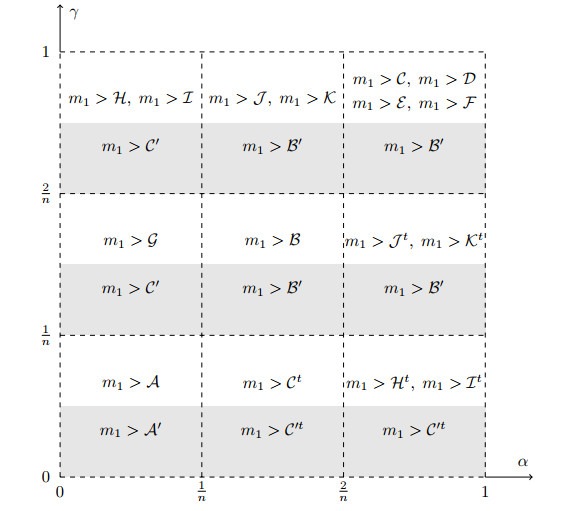
  • Figure 1.  Schematization of the non-logistic case (Theorem 2.2, non-shadowed zones) and the logistic case (Theorem 2.3, shadowed zones). With reference to $ \S $2.1.1, {herein we collect} the ranges of the parameters involved in model (2.1) for which boundedness of its solutions is established for any fixed initial distribution $ u_0, v_0 $ and $ w_0 $. (Recall $ m_2, m_3, k\in {\mathbb R} $ and $ \chi, \xi \in {\mathbb R}^+ $. For the analysis of the limit values of $ \alpha $ and $ \gamma $ in the corresponding intervals, we refer to the mentioned theorems.).

  • [1] K. Baghaei and A. Khelghati, Boundedness of classical solutions for a chemotaxis model with consumption of chemoattractant, C. R. Math. Acad. Sci. Paris, 355 (2017), 633-639.  doi: 10.1016/j.crma.2017.04.009.
    [2] Y. Chiyo, M. Marras, Y. Tanaka and T. Yokota, Blow-up phenomena in a parabolic-elliptic-elliptic attraction-repulsion chemotaxis system with superlinear logistic degradation, Nonlinear Anal., 212 (2021), Paper No. 112550. doi: 10.1016/j.na.2021.112550.
    [3] S. Frassu, R. Rodríguez Galván and G. Viglialoro, Uniform in time $L^\infty$-estimates for an attraction-repulsion chemotaxis model with double saturation, Discret. Contin. Dyn. Syst. Ser. B, 28 (2023), 1886-1904.  doi: 10.3934/dcdsb.2022151.
    [4] S. Frassu, C. van der Mee and G. Viglialoro, Boundedness in a nonlinear attraction-repulsion Keller–Segel system with production and consumption, J. Math. Anal. Appl., 504 (2021), 125428.  doi: 10.1016/j.jmaa.2021.125428.
    [5] S. Frassu and G. Viglialoro, Boundedness for a fully parabolic Keller–Segel model with sublinear segregation and superlinear aggregation, Acta Appl. Math., 171 (2021), 1-20.  doi: 10.1007/s10440-021-00386-6.
    [6] S. Frassu and G. Viglialoro, Boundedness in a chemotaxis system with consumed chemoattractant and produced chemorepellent, Nonlinear Anal., 213 (2021), 112505.  doi: 10.1016/j.na.2021.112505.
    [7] Q. Guo, Z. Jiang and S. Zheng, Critical mass for an attraction-repulsion chemotaxis system, Appl. Anal., 97 (2018), 2349-2354.  doi: 10.1080/00036811.2017.1366989.
    [8] M. B. Hallett, Molecular and Cellular Biology of Phagocytosis, Springer International Publishing, 2020.
    [9] E. F. Keller and L. A. Segel, Initiation of slime mold aggregation viewed as an instability, J. Theoret. Biol., 26 (1970), 399-415.  doi: 10.1016/0022-5193(70)90092-5.
    [10] E. F. Keller and L. A. Segel, Model for chemotaxis, J. Theoret. Biol., 30 (1971), 225-234. 
    [11] E. F. Keller and L. A. Segel, Traveling bands of chemotactic bacteria: A theoretical analysis, J. Theoret. Biol., 30 (1971), 235-248. 
    [12] J. Lankeit and Y. Wang, Global existence, boundedness and stabilization in a high-dimensional chemotaxis system with consumption, Discrete Contin. Dyn. Syst., 37 (2017), 6099-6121.  doi: 10.3934/dcds.2017262.
    [13] Y. Li and Y. Li, Blow-up of nonradial solutions to attraction-repulsion chemotaxis system in two dimensions, Nonlinear Anal. Real World Appl., 30 (2016), 170-183.  doi: 10.1016/j.nonrwa.2015.12.003.
    [14] M. Luca, A. Chavez-Ross, L. Edelstein-Keshet and A. Mogilner, Chemotactic signaling, microglia, and Alzheimer's disease senile plaques: Is there a connection?, Bull. Math. Biol., 65 (2003), 693-730. 
    [15] M. Marras and G. Viglialoro, Boundedness in a fully parabolic chemotaxis-consumption system with nonlinear diffusion and sensitivity, and logistic source, Math. Nachr., 291 (2018), 2318-2333.  doi: 10.1002/mana.201700172.
    [16] Y. Tao, Boundedness in a chemotaxis model with oxygen consumption by bacteria, J. Math. Anal. Appl., 381 (2011), 521-529.  doi: 10.1016/j.jmaa.2011.02.041.
    [17] Y. Tao and Z.-A. Wang, Competing effects of attraction vs. repulsion in chemotaxis, Math. Models Methods Appl. Sci., 23 (2013), 1-36.  doi: 10.1142/S0218202512500443.
    [18] Y. Tao and M. Winkler, Boundedness in a quasilinear parabolic-parabolic Keller–Segel system with subcritical sensitivity, J. Differ. Equ., 252 (2012), 692-715.  doi: 10.1016/j.jde.2011.08.019.
    [19] G. Viglialoro, Explicit lower bound of blow-up time for an attraction-repulsion chemotaxis system, J. Math. Anal. App., 479 (2019), 1069-1077.  doi: 10.1016/j.jmaa.2019.06.067.
    [20] G. Viglialoro, Influence of nonlinear production on the global solvability of an attraction-repulsion chemotaxis system, Math. Nachr., 294 (2021), 2441-2454.  doi: 10.1002/mana.201900465.
    [21] M. Winkler, Global large-data solutions in a chemotaxis-(Navier–)Stokes system modeling cellular swimming in fluid drops, Commun. Partial Differ. Equ., 37 (2012), 319-351.  doi: 10.1080/03605302.2011.591865.
    [22] M. Winkler, Stabilization in a two-dimensional chemotaxis-Navier–Stokes system, Arch. Ration. Mech. Anal., 212 (2014), 455-487.  doi: 10.1007/s00205-013-0678-9.
  • 加载中

Figures(1)

SHARE

Article Metrics

HTML views(4305) PDF downloads(148) Cited by(0)

Access History

Other Articles By Authors

Catalog

    /

    DownLoad:  Full-Size Img  PowerPoint
    Return
    Return