\`x^2+y_1+z_12^34\`
Advanced Search
Article Contents
Article Contents

Minimal wave speed for a population model with density-dependent migrations and the Allee effect

In memory of the late Professor Masayasu Mimura

The author is supported by MOST (111-2115-M-007-009-MY3) and NCTS.

Abstract / Introduction Full Text(HTML) Figure(6) Related Papers Cited by
  • In this paper, we study the minimal wave speed for a class of population models with density-dependent migration speed and the Allee effect. We first give the exact expression for the minimal wave speed for the case of linear migration speed. This in turn specifies a critical curve in the parameter plane of the migration speed and the Allee effect which separates a region of the linear determinacy of the minimal wave speed from a region of the nonlinear determinacy of the minimal wave speed. Next, for a class of nonlinear migration speed, the corresponding minimal wave speed is shown to enjoy similar qualitative properties as depicted in the case of linear migration speed.

    Mathematics Subject Classification: Primary: 34A34, 34A12, 35K57.

    Citation:

    \begin{equation} \\ \end{equation}
  • 加载中
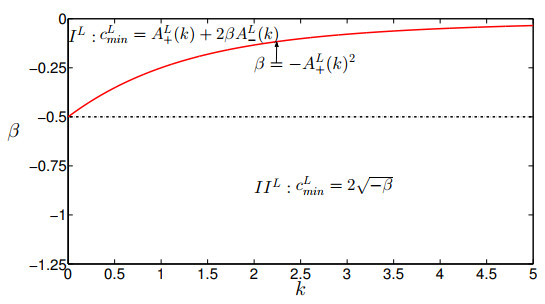
  • Figure 1.  The dependence of the minimal wave speed $ c_{min}^L = c_{min}^L(k,\beta) $ on the parameters $ k $ and $ \beta $. $ c_{min}^L = A_+^L(k)+2\beta A_-^L(k) $ in the region $ I^L $, while $ c_{min}^L = 2\sqrt{-\beta} $ in the region $ II^L $.

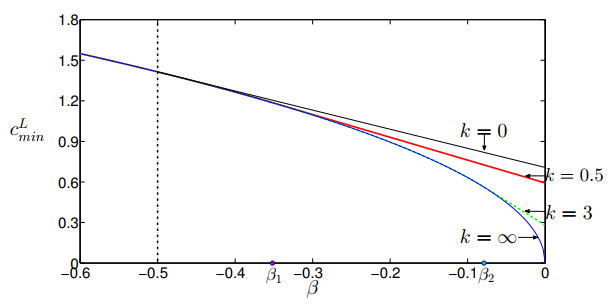
    Figure 2.  Dependence of the minimal wave speed $ c_{min}^L = c_{min}^L(k,\beta) $ on the parameter $ \beta $ for various fixed parameter values $ k $. The black thin line: $ k = k_0 = 0 $. The red solid line: $ k = k_1 = 0.5 $. The green dashed line: $ k = k_2 = 3 $. The blue thin line: $ k = \infty $. For $ i = 0,1,2 $, $ c_{min}^L = 2\sqrt{-\beta} $ for $ \beta\le\beta_i: = -A_+^L(k_i)^2 $, while $ c_{min}^L = A_+^L(k_i)+2\beta A_-^L(k_i) $ for $ \beta\in(\beta_i,0) $. Note that $ \beta_0 = -1/2 $, and these four curves are identical for $ \beta\le\beta_0 = -1/2 $.

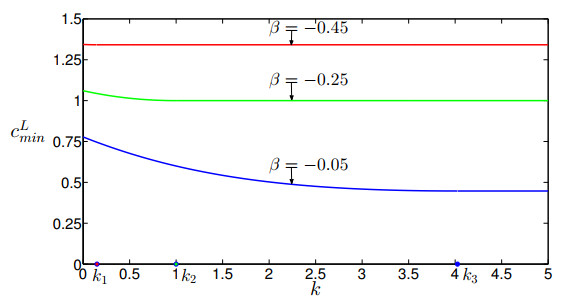
    Figure 3.  Dependence of the minimal wave speed $ c_{min}^L = c_{min}^L(k,\beta) $ on the parameter $ k $ for various fixed parameter values $ \beta $. The red line: $ \beta = \beta_1 = -0.45 $. The green line: $ \beta = \beta_2 = -0.25 $. The blue line: $ \beta = \beta_3 = -0.05 $. For $ i = 1,2,3 $, let $ k_i $ be the unique root of $ A_+^L(k)^2 = -\beta_i $. Then $ c_{min}^L = 2\sqrt{-\beta_i} $ for $ k\ge k_i $, while $ c_{min}^L = A_+^L(k)+2\beta_i A_-^L(k) $ for $ k\in[0,k_i] $.

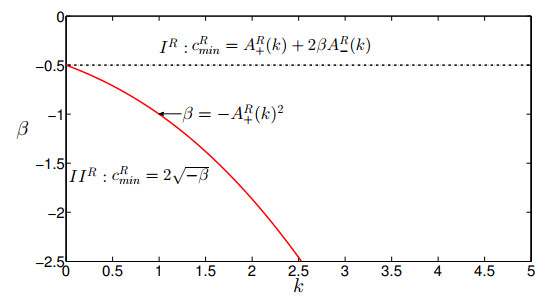
    Figure 4.  The dependence of the minimal wave speed $ c_{min}^R = c_{min}^R(k,\beta) $ on the parameters $ k $ and $ \beta $. $ c_{min}^R = A_+^R(k)+2\beta A_-^R(k) $ in the region $ I^R $, while $ c_{min}^R = 2\sqrt{-\beta} $ in the region $ II^R $.

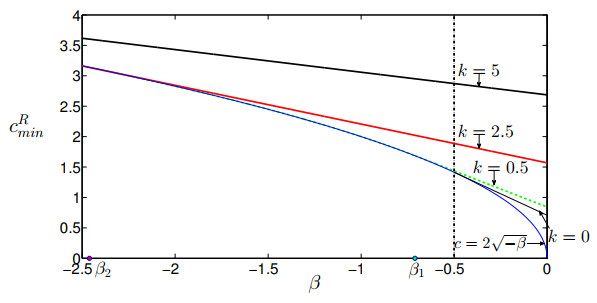
    Figure 5.  Dependence of the minimal wave speed $ c_{min}^R = c_{min}^R(k,\beta) $ on the parameter $ \beta $ for various fixed parameter values $ k $. The black solid line: $ k = k_3 = 5 $. The red solid line: $ k = k_2 = 2.5 $. The green dashed line: $ k = k_1 = 0.5 $. The black thin line: $ k = k_0 = 0 $. The blue thin line: $ c = 2\sqrt{-\beta} $. For $ i = 0,1,2,3 $, $ c_{min}^R = 2\sqrt{-\beta} $ for $ \beta\le\beta_i: = -A_+^R(k_i)^2 $, while $ c_{min}^R = A_+^R(k_i)+2\beta A_-^LR(k_i) $ for $ \beta\in(\beta_i,0) $. Here $ \beta_0 = -1/2 $. Note that these five curves are identical for $ \beta\le\min_{i = 0,1,2,3}\beta_i = \beta_3 $, and that $ \beta_3 $ is not shown in the figure.

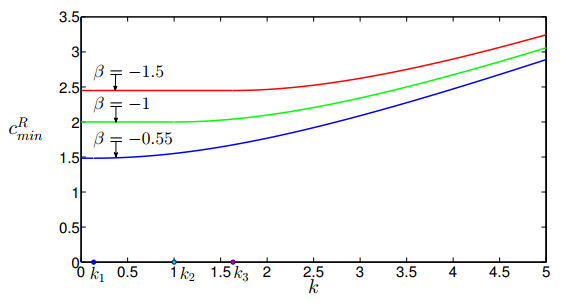
    Figure 6.  Dependence of the minimal wave speed $ c_{min}^R = c_{min}^R(k,\beta) $ on the parameter $ k $ for various fixed parameter values $ \beta $. The red line: $ \beta = \beta_3 = -1.5 $. The green line: $ \beta = \beta_2 = -1 $. The blue line: $ \beta = \beta_1 = -0.55 $. For $ i = 1,2,3 $, let $ k_i $ be the unique root of $ A_+^R(k)^2 = -\beta_i $. Then $ c_{min}^R = 2\sqrt{-\beta_i} $ for $ k\in[0,k_i] $, while $ c_{min}^R = A_+^R(k)+2\beta_i A_-^R(k) $ for $ k\ge k_i $.

  • [1] J. An, C. Henderson and L. Ryzhik, Pushed, pulled and pushmi-pullyu fronts of the Burgers-FKPP equation, to appear, J. Eur. Math. Soc..
    [2] D. G. Aronson and H. F. Weinberger, Nonlinear diffusion in population genetics, combustion, and nerve pulse propagation, Partial Differential Equations and Related Topics, Lecture notes in Mathematics, Springer-Verlag, Berlin, 446 (1975), 5-49.
    [3] D. G. Aronson and H. F. Weinberger, Multidimensional nonlinear diffusion arising in population genetics, Adv. in Math., 30 (1978), 33-76.  doi: 10.1016/0001-8708(78)90130-5.
    [4] C. J. A. Bradshaw, B. Leroy, C. Bellard, D. Roiz, C. Albert, A. Fournier, M. Barbet-Massin, J.-M. Salles, F. Simard and F. Courchamp, Massive yet grossly underestimated global costs of invasive insects, Nat. Commun., 7 (2016), Article number: 12986.
    [5] E. C. M. Crooks, Travelling fronts for monostable reaction-diffusion systems with gradient-dependence, Adv. Differential Equations, 8 (2003), 279-314. 
    [6] E. C. M. Crooks, M. Grinfeld and G. McKay, Minimality conditions for wave speed in anisotropic smectic $C^*$ liquid crystals, Math. Methods Appl. Sci., 41 (2018), 88-102.  doi: 10.1002/mma.4596.
    [7] R. A. Fisher, The wave of advance of advantageous genes, Ann. Eugenics, 7 (1937), 353-369. 
    [8] K. P. Hadeler and F. Rothe, Travelling fronts in nonlinear diffusion equations, J. Math. Biol., 2 (1975), 251-263.  doi: 10.1007/BF00277154.
    [9] A. N. Kolmogorov, I. G. Petrovsky and N. S. Piscounov, A study of the diffusion equation with increase in the amount of substance, and its application to a biological problem, Bull. Moscow Univ. Math. Mech., 1 (1937), 1-26. 
    [10] X. Liang and X.-Q. Zhao, Spreading speeds and traveling waves for abstract monostable evolution systems, J. Funct. Anal., 259 (2010), 857-903.  doi: 10.1016/j.jfa.2010.04.018.
    [11] R. Lui, Biological growth and spread modeled by systems of recursions. I Mathematical theory, Math. Biosci., 93 (1989), 269-295.  doi: 10.1016/0025-5564(89)90026-6.
    [12] L. Malaguti and C. Marcelli, Travelling wavefronts in reaction-diffusion equations with convection effects and non-regular terms, Math. Nachr., 242 (2002), 148-164.  doi: 10.1002/1522-2616(200207)242:1<148::AID-MANA148>3.0.CO;2-J.
    [13] H. Malchow, S. V. Petrovskii and E. Venturino, Spatiotemporal Patterns in Ecology and Epidemiology: Theory, Models, and Simulation, Chapman & Hall/CRC, New York, 2008.
    [14] J. D. Murray, Mathematical Biology. I: An introduction, $3^{rd}$ edition, Springer-Verlag, New York, 2002.
    [15] A. Okubo, Diffusion and Ecological Problems: Mathematical Models, Biomathematics, 10. Springer-Verlag, Berlin-New York, 1980.
    [16] A. Okubo and S. Levin, Diffusion and Ecological Problems: Modern Perspectives, $^{nd}$ edition, Interdisciplinary Applied Mathematics Series 14, Springer-Verlag, New York, 2001. doi: 10.1007/978-1-4757-4978-6.
    [17] M. R. Owen and M. A. Lewis, How predation can slow, stop or reverse a prey invasion, Bull. Math. Biol., 63 (2001), 655-684.  doi: 10.1006/bulm.2001.0239.
    [18] S. V. Petrovskii and B.-L. Li, An exactly solvable model of population dynamics with density-dependent migrations and the Allee effect, Math. Biosci., 186 (2003), 79-91.  doi: 10.1016/S0025-5564(03)00098-1.
    [19] S. V. Petrovskii and  B.-L. Li,  Exactly Solvable Models of Biological Invasion, CRC Press, CRC Mathematical Biology and Medicine Series. Boca Raton, 2006. 
    [20] N. Shigesada and  K. Kawasaki,  Biological Invasions: Theory and Practice, Oxford University Press, UK, 1997. 
    [21] A. I. Volpert, V. A. Volpert and V. A. Volpert, Traveling-wave Solutions of Parabolic Systems, Translations of Mathematical Monographs 140, American Mathematical Society, Providence, R. I., 1994. doi: 10.1090/mmono/140.
    [22] H. F. Weinberger, Long-time behavior of a class of biological models, SIAM J. Math. Anal., 13 (1982), 353-396.  doi: 10.1137/0513028.
  • 加载中

Figures(6)

SHARE

Article Metrics

HTML views(4437) PDF downloads(299) Cited by(0)

Access History

Other Articles By Authors

Catalog

    /

    DownLoad:  Full-Size Img  PowerPoint
    Return
    Return