In previous work we considered a model of a dynamically evolving network of interactions between a group of individuals, where each individual has an optimum level of social engagement with other group members. A randomly selected individual will form or break a link to obtain the required number of contacts. These interactions were formulated as a graph realisation problem. This short paper considers a game-theoretical version of the model, where individuals strategically choose the specific link to form or break. This game is known from previous work to be very complex for all but almost trivial cases, with the exception of an example with three players considered by Broom and Cannings. We revisit this example and show that even this is more complex than previously thought. In this paper, we find a general expression for the payoff functions for all possible strategy combinations. In addition to the three Nash equilibria previously found, we find a set of six more. The considerations of all possibilities proves to be infeasible, leaving the possibility of more solutions open.
| Citation: |
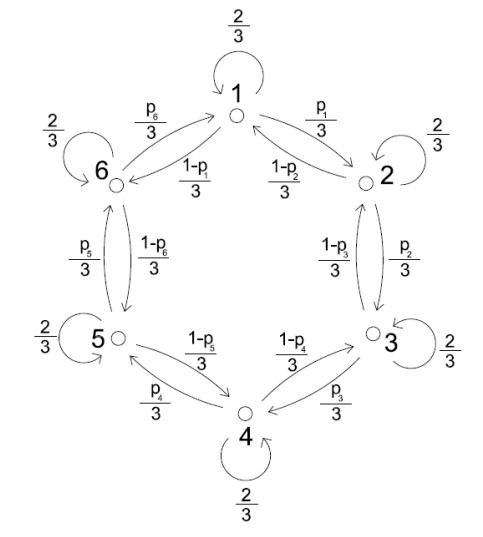
Figure 1. Transition graph of the sequence 111 showing the minimal set in every possible move at each of the six vertices. Vertex 1 represents the sequence 211, i.e. individual $ v_{1} $ is the one in deficit and moves clockwise to sequence 101 with probability $ \frac{p_1}{3} $ and anticlockwise to 110 with probability $ \frac{1-p_1}{3} $, it will stay in the same state with probability $ \frac{2}{3} $. Similarly, vertex 2 represents sequence 101, vertex 3 represents sequence 112, vertex 4 represents sequence 011, vertex 5 represents sequence 121 and vertex 6 represents sequence 110.
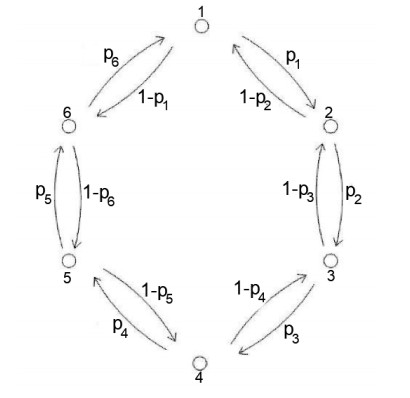
Figure 3. Transition graph of the sequence 111 showing the first solution of the cyclic set, solution 4: Straight arrows $ \searrow $: when $ p_i = 1 $, individual $ v_i $ will move clockwise. Straight arrows $ \nwarrow $:when $ p_i = 0 $, individual $ v_i $ will move anti-clockwise. Curved arrows: for $ 0<p_i<1 $ the movement of individual $ v_i $ to the next state could happen in either direction, clockwise with probability $ p_i $ or anti-clockwise with probability $ 1-p_i $.
| [1] |
R. Aizouk and M. Broom, Modelling conflicting individual preference: Target sequences and graph realization, Discrete & Continuous Dynamical Systems-B, 27 (2022), 6373-6400.
doi: 10.3934/dcdsb.2022001.
|
| [2] |
M. Broom and C. Cannings, A dynamic network population model with strategic link formation governed by individual preferences, Journal of Theoretical Biology, 335 (2013), 160-168.
doi: 10.1016/j.jtbi.2013.06.024.
|
| [3] |
M. Broom and C. Cannings, Graphic deviation, Discrete Mathematics, 338 (2015), 701-711.
doi: 10.1016/j.disc.2014.12.011.
|
| [4] |
M. Broom and C. Cannings, Game theoretical modelling of a dynamically evolving network I: General target sequences, Journal of Dynamics and Games, 4 (2017), 285-318.
doi: 10.3934/jdg.2017016.
|
| [5] |
C. Cannings and M. Broom, Game theoretical modelling of a dynamically evolving network Ⅱ: Target sequences of score 1, Journal of Dynamics & Games, 7 (2020), 37-64.
doi: 10.3934/jdg.2020003.
|
| [6] |
J. K. Carter, B. Shorrocks, K. D. Carter, R. Brand and A. W. Goldizen, Social networks, long-term associations and age-related sociability of wild giraffes, Animal Behaviour, 86 (2013), 901-910.
doi: 10.1016/j.anbehav.2013.08.002.
|
| [7] |
S Hakami, On the realizability of a set of integers as degrees of the vertices of a graph, SIAM Journal Applied Mathematics, 10 (1962), 496-506.
doi: 10.1137/0110037.
|
| [8] |
V. Havel, A remark on the existence of finite graphs, Časopis Pěst. Mat., 81 (1956), 405-409.
doi: 10.21136/CPM.1956.117224.
|
| [9] |
M. R. Heithaus, R. C. Connor and L. M. Barre, Superalliance of bottlenose dolphins, Nature, 397 (1999), 571-572.
doi: 10.1038/17501.
|
| [10] |
M. O. Jackson and A. Wolinsky, A strategic model of social and economic networks, Journal of economic theory, 71 (1996), 44-74.
doi: 10.1006/jeth.1996.0108.
|
| [11] |
R. Noë, Biological markets: Partner choice as the driving force behind the evolution of cooperation, Economics in Nature. Social Dilemmas, Mate Choice and Biological Markets, ed. R. Noe, JARAM van Hooff & P. Hammerstein, 2001, 93118.
|
| [12] |
R. Noë and P. Hammerstein, Biological markets: Supply and demand determine the effect of partner choice in cooperation, mutualism and mating, Behavioral Ecology and Sociobiology, 35 (1994), 1-11.
|
| [13] |
E. Ruch and I. Gutman, The branching extent of graphs, J. Combin. Inform. System Sci., 4 (1979), 285-295.
|
| [14] |
A. M. Sibbald and R. J. Hooper, Sociability and the willingness of individual sheep to move away from their companions in order to graze, Applied Animal Behaviour Science, 86 (2004), 51-62.
doi: 10.1016/j.applanim.2003.11.010.
|
| [15] |
D. B. West, Introduction to Graph Theory, volume 2., Prentice hall Upper Saddle River, NJ, 1996.
|
Transition graph of the sequence 111 showing the minimal set in every possible move at each of the six vertices. Vertex 1 represents the sequence 211, i.e. individual
Transition graph of the sequence 111 showing the minimal set in every possible move at each of the six vertices. Vertex
Transition graph of the sequence 111 showing the first solution of the cyclic set, solution 4: Straight arrows